On this article
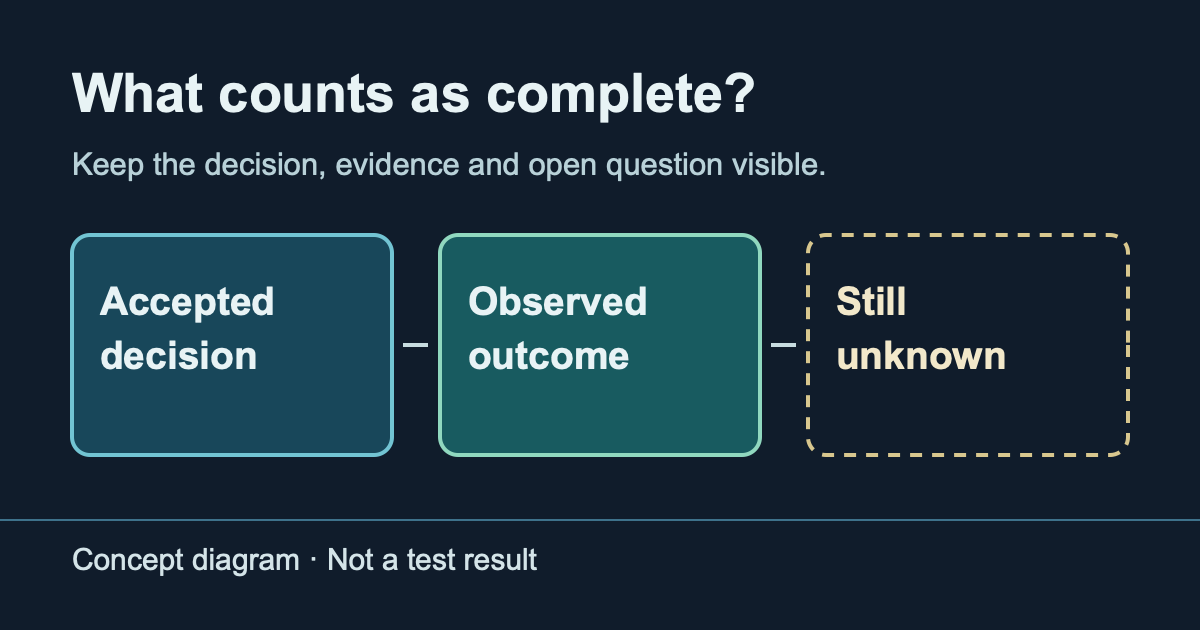
When delegated work is reported as complete, I want to know which outcome that claim covers. A Novasean launch record shows why the question matters: an organisation can authorise a service to go live while still lacking evidence of a complete customer journey. For governed AI autonomy, I propose making the acceptance decision, the observed behaviour and the remaining uncertainty separately visible in completion reports.
On 5 October 2026, Novasean's operational release record described the store as open and recorded management acceptance of its launch capability. It also explicitly recorded a gap: the available component tests did not establish one current order passing through payment, provisioning and the welcome message. A live customer sale was not claimed.
Those statements can coexist. Permission to operate is a decision taken on available evidence and accepted assumptions. A completed customer journey is an observation that needs its own evidence. Confusing them would turn an authorised next step into a result we had not established.
The practical question for this first Field Note is: when work is delegated, what should a completion report let the next decision maker distinguish?
Start with the claim being made
I use AI operating model to mean the arrangements for assigning work to AI, setting its authority, checking results and retaining accountability. Governed autonomy, as I use it here, means allowing work within explicit boundaries while keeping its decisions and outcomes open to scrutiny. These are working definitions for this series.
The launch record is useful because “the store is open” could easily become an overbroad summary. The underlying evidence supported more specific statements:
| What the 5 October record reported | What that statement establishes within the record |
|---|---|
| The production ordering route was enabled and launch capability was operationally accepted. | An installed state and an acceptance decision. |
| An earlier payment test in a sandbox succeeded, without provisioning a service. | Payment component evidence in a test environment. |
| Separate service-creation exercises produced usable services and checked their cleanup. | Service-delivery component evidence, separate from the payment test. |
| Some operating assumptions were explicitly accepted from the business owner. | Stated and accepted inputs, rather than newly executed tests. |
| No complete current payment-to-provisioning-to-welcome trace or live customer sale was claimed. | An explicit limit on the outcome supported by this record. |
The record also describes a concrete defect and correction. A test reproduced a problem in the earlier welcome-message guard: it could suppress a valid service welcome because the durable acceptance record was not yet bound when the message was prepared. A corrected guard was installed on 5 October after passing 72 test fixtures and a direct callback check against the actual database schema. That callback check sent no email and triggered no native checkout or payment event. This supports a bounded correction of the reproduced defect; it does not establish actual welcome delivery or the complete journey through one order. The defect belongs to the predecessor described in the record, rather than being presented here as an unresolved fault in the corrected guard.
This is a reading of one internal release record. I have not treated it as an independent audit of every underlying test. It describes the recorded position on 5 October, rather than establishing the current state of every system when this article is read.
The distinction matters at the handover. A colleague deciding what to observe next needs to know that the guard was corrected and that actual message delivery remained unobserved in this evidence. “Accepted for launch” cannot convey those two facts on its own.
What this observation adds to the AOM
My interpretation is that completion reports should preserve two separate judgements: what the responsible owner has accepted, and what the evidence demonstrates. A decision can legitimately proceed with uncertainty; the report should retain that uncertainty for the person or agent acting next.
For the AOM, I propose a small reporting check: whenever a report says “complete”, specify the outcome that is complete, the evidence supporting it, and the next outcome still unobserved. In this case, store-opening work could close while the first real paid service remained the next operational observation.
This is a proposal about reporting clarity. This Field Note does not enact a new operating rule, establish that the existing launch decision was optimal, or show that the AOM improved delivery. The observed record already preserved the distinction; the proposed check would test whether later summaries preserve it too.
An external perspective, with a different evidence boundary
In its engineering article Building effective agents, Anthropic recommends that agents assess progress using feedback from the environment, including tool results and executed code, and describes checkpoints and stopping conditions. It also recommends beginning with the simplest suitable solution and increasing complexity when justified. These are the publisher's engineering recommendations. They do not validate Novasean's release or demonstrate the effectiveness of our operating model. Anthropic, Building effective agents, 19 December 2024.
I take a related question from that guidance: after an agent receives feedback, does its report preserve what the feedback actually established? A successful tool response may support a component claim. Extending that claim to a complete business outcome requires further evidence. That extension is my interpretation, not a result reported by Anthropic about Novasean.
The ordinary explanation deserves equal attention
There is a straightforward alternative explanation for this case: ordinary release management produced a careful record. Payment systems, provisioning software, technical checks and accountable decisions can explain the recorded launch state without attributing it to AI.
The source does not isolate AI's contribution. There is no comparison here between equivalent work performed with and without the AOM, no measured reduction in errors or effort, and no demonstrated commercial improvement. Even a later completed sale would establish a customer outcome for that transaction; it would not, by itself, establish that AI caused it.
The missing complete trace is also a limit on observation. It does not prove that the journey would fail. Conversely, successful component tests do not prove that every handover between those components works under real conditions. Both errors would overstate what this record can tell us.
A next test small enough to challenge
I propose testing the reporting check on a bounded set of completed work packages. Before reviewing them, freeze each package's acceptance criteria and source evidence. Ask a reviewer to mark every completion claim whose scope exceeds that evidence, and every material uncertainty omitted from the summary. Record disagreements and corrections as well as apparent successes.
The hypothesis would be modest: explicitly separating acceptance, observation and uncertainty makes unsupported completion claims easier to detect. A useful comparison would ask independent reviewers to assess summaries of the same evidence with and without that structure, using the same criteria. The method, allocation and scoring would need agreement before running it. No such comparison is reported here.
The launch record identifies observation of the first real paid service as the next operational step. That would answer a different question: what happened along one actual customer journey? Keeping these two questions separate lets us learn about service delivery and about the quality of our reporting without making either result stand in for the other.
For practitioners, the immediate check is simple: take a recent completion report and underline its outcome claim. Can the next person see exactly what was accepted, what was observed and what remains unknown?
Evidence and disclosure
Own practice evidence: Novasean's internal Live launch release — 5 October 2026 record, including its welcome-ordering correction and operational-acceptance sections. This article provides a bounded account of the record, not a public reproduction of the underlying operational evidence or an independently reproducible audit. The internal source is retained for editorial verification.
External primary source: Anthropic's engineering article linked above, checked on 7 October 2026. It is used as evidence of the publisher's stated recommendations. No external secondary analysis is relied upon.
Interpretation and hypothesis: the proposed completion-report check, its relevance to governed autonomy and the proposed comparison are my interpretation and future research questions. They are not measured findings about AOM effectiveness.
AI tools assisted source checking, drafting and editing. I remain the named author and accountable editor of this series.